
Reviewed · TÜRKIYE
Highlights of Konya
Konya’s spiritual heart is the Mevlana Museum, where the turquoise dome marks the tomb of Mevlana Celaleddin Rumi and the former home of the whirling dervishes. I like that this tour does not stop with Rumi. It also takes you to Sille, an old Christian settlement with rock-cut churches, giving you a fuller picture of Konya’s past.
I especially like the private vehicle and flexible format, useful when you have only one day or arrive by air. The included à la carte lunch with drinks is another practical plus. The main drawback is pace: seven stops in one day leave limited time at several sites, and the two-hour visit to Sille may feel short if you want to explore every church and alley.
In This Review
- Key points at a glance
- Why this private Konya tour works well in one day
- Mevlana Museum: the essential two-hour stop
- Alaeddin Mosque and the Seljuk center of Konya
- Karatay Medresesi: tilework in a former school
- Aziziye Mosque and its unusual European influence
- Sille village: Konya’s Christian past
- Aya Elena Church and the Helena story
- Shams-i Tabrizi: the companion behind Rumi’s inspiration
- Lunch, transport, and the real value of $100
- Who should book this experience?
- Timing, booking, and cancellation
- Should you book the Highlights of Konya tour?
- FAQ
- How long does the Highlights of Konya tour last?
- Is this a private tour?
- Is hotel pickup included?
- What is included in the $100 price?
- Is lunch included?
- Which sites are included?
- Are admission tickets included?
- What is the cancellation policy?
Key points at a glance
- Rumi’s Konya in context: Spend about two hours at the Mevlana Museum, the city’s most important spiritual site.
- Private touring: Your group travels together by private vehicle with a professional guide and hotel pickup and drop-off.
- A useful mix of faiths and periods: See Seljuk mosques, Ottoman-era architecture, Sufi memorials, and early Christian churches.
- Sille adds a different Konya: The old village brings rock-carved churches and monastery history into the day.
- Lunch is included: An à la carte meal with drinks is part of the package, not an extra expense.
- Best for a one-day visit: The route gives you a broad introduction without requiring several separate bookings.
Why this private Konya tour works well in one day
Konya is often reduced to one subject: Rumi and the whirling dervishes. That would be a mistake. The city also carries Seljuk, Ottoman, Byzantine, and early Christian stories, and this full-day route gives each one some space.
The tour runs for roughly seven to eight hours. You meet your guide in the morning at your hotel, then move between central Konya and Sille in a private vehicle. That saves time and gives your guide room to adjust the day for your interests, within the fixed opening hours and visit schedule.
I would choose this format if you have one free day in Konya and want more than a quick museum stop. It is also a good fit for people who prefer explanations at the site rather than moving from monument to monument with only a name and date.
The private setup matters. You do not share the activity with unrelated groups, and the guide can spend more time on Sufism, architecture, local traditions, or the history of the churches, depending on what interests you. Fatma is specifically associated with several especially personal and informative tours, while Mete is also named as a professional guide and organizer.
Still, private does not mean slow. The route covers a lot. Expect short stops at Aziziye Mosque and Aya Elena Church, while the Mevlana Museum and Sille receive the longest visits.
Other Turkiye days worth putting on the list:
- Istanbul: Bosphorus Dinner Cruise & Show with Private Table
★ 4.8 · 44,561 reviews - Istanbul: Daytime or Sunset Sightseeing Cruise & Audio Guide
★ 4.8 · 14,430 reviews - Istanbul: Bosphorus Dinner Cruise with Turkish Night Show
★ 4.8 · 10,127 reviews
Mevlana Museum: the essential two-hour stop
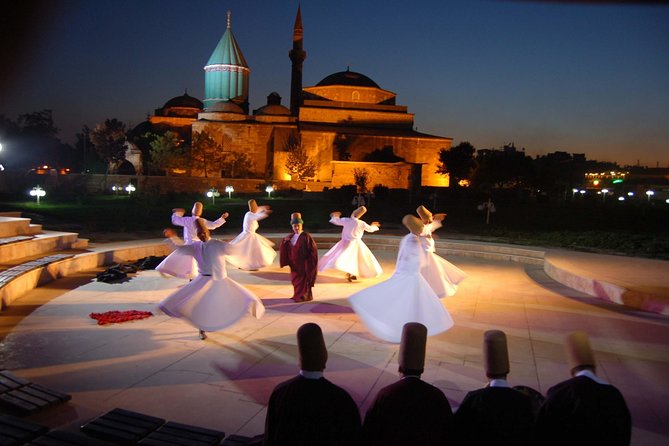
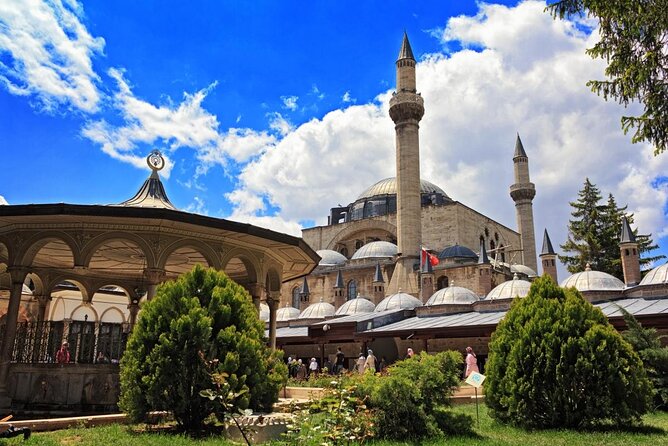
Start here if you want to understand why Konya matters. The Mevlana Museum occupies the former lodge of the whirling dervishes and contains the tomb of Mevlana Celaleddin Rumi, the 13th-century poet, teacher, and Sufi figure.
The building’s fluted turquoise dome is one of the most recognizable sights in Turkey. The color is striking, but the meaning of the place matters more than the postcard view. This was a working Sufi center, not simply a memorial built for display.
Your guide can help explain Rumi’s connection to the Mevlevi order and the spiritual ideas linked with the whirling dervishes. That background is valuable because the rituals can otherwise seem mysterious when seen without context.
Two hours is a sensible amount of time here. It gives you room to see the main spaces, pause at the tomb, and listen without turning the visit into a hurried photo stop. If Rumi is your main reason for coming to Konya, you may wish the tour offered even longer here, but the rest of the route is what makes this more than a single-site outing.
Dress and behave respectfully. This remains a sacred place for many people, not just a historic building. Your guide can help you understand the expected etiquette.
Alaeddin Mosque and the Seljuk center of Konya
The Alaeddin Mosque takes you back to the Seljuk period. Construction took place between 1116 and 1220 under the Seljuk Sultans of Rum, making it one of Turkey’s oldest mosques.
The building has an unusual visual character. Its columns vary in size and appear to come from earlier periods, a reminder that historic buildings are often assembled from materials and traditions that predate the structure itself.
The mosque also connects with the Seljuk palace built during the reign of Sultan Kılıçarslan II, who ruled from 1156 to 1192. Your 30-minute stop is brief, but it should give you a useful introduction to Konya as a Seljuk capital.
I like this part of the route because it balances the more personal story of Rumi with the political and architectural history of the city. The drawback is that half an hour leaves little room for a slow look at every detail. Listen closely to the guide here, since the explanation will add much of the value.
Admission is free.
Karatay Medresesi: tilework in a former school
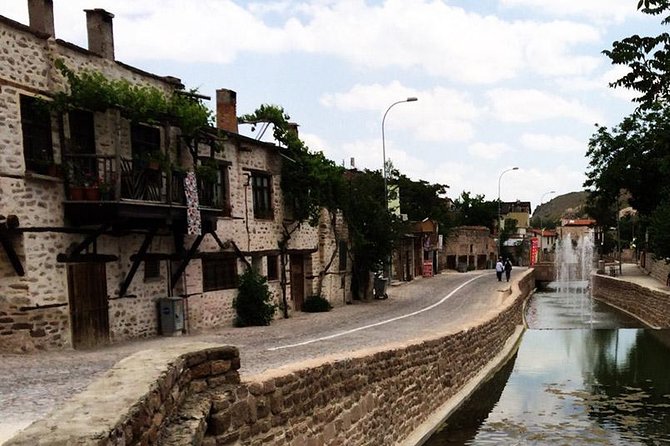
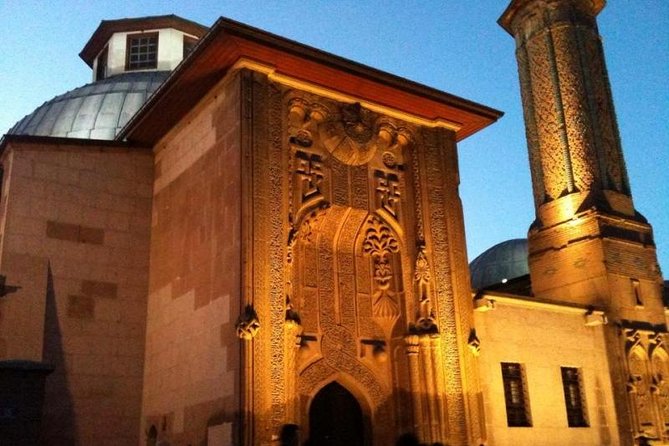
Built in 1252 during the Seljuk period, Karatay Medresesi once served as a theological school. Today, it houses historical tiles, making it a compact but worthwhile stop for anyone interested in decoration, craft, and Islamic architecture.
You have about 20 minutes here. That is enough for a focused visit, especially with a guide pointing out the most important pieces. It is not enough for an unhurried museum study, so do not expect a large free period.
The contrast with the Mevlana Museum is useful. There, the focus is a religious figure and a Sufi lodge. Here, the focus shifts toward education, design, and Seljuk artistic skill. The stop also helps explain how Konya developed as a center of religious learning.
Admission is included.
Same city, a completely different kind of day:
- Best of Istanbul 1, 2 or 3-Day Private Guided Istanbul Tour
★ 5.0 · 8,922 reviews - FOR CRUISERS: Skip The Lines PRIVATE EPHESUS TOUR &On Time Return
★ 5.0 · 8,527 reviews - Istanbul: Basilica Cistern Fast-Track Entry and Audio Guide
★ 4.6 · 7,521 reviews - Top Choice For Cruisers: Ephesus, Mary’s House WITH TICKETS+LUNCH
★ 5.0 · 7,233 reviews
Aziziye Mosque and its unusual European influence
Aziziye Mosque is a quick 10-minute stop, but it is one of the more visually distinctive buildings on the route. It was first built in the 17th century, then restored about 200 years later after a fire.
That later rebuilding produced a mosque with Baroque and Rococo features. The style contrasts sharply with the simpler and more familiar forms associated with many Ottoman and Seljuk mosques.
Ten minutes is enough to see the exterior and hear the basic story. It is not a long interior visit. I would treat this as an architectural punctuation mark between the larger historical stops, not as a major museum experience.
This is also a good example of why a guide helps. Without the fire and later reconstruction story, you might simply wonder why the mosque looks different from the others.
Admission is free.
Sille village: Konya’s Christian past
Sille is the route’s strongest change of scene. The village dates back to the eighth or seventh century BC and is described as an old Roman settlement and an early Christian residence.
The area is known for rock-carved churches and monasteries, including the site associated with St. Chariton, also called Ak Monastery. That gives you a view of Konya’s religious past before and beyond the Islamic monuments in the city center.
The tour allows about two hours in Sille, the second-longest stop after the Mevlana Museum. That is important because the village requires more than a quick photograph. You need time to walk, look at the old structures, and take in the connection between the settlement and the surrounding rock.
Sille is where the private format may be most useful. You can ask your guide to explain the Christian communities, the churches, and Helena’s connection with the village. The route description does not promise unlimited exploration of every site, so keep your expectations practical. You are getting an introduction, not a full archaeological field day.
I would not skip Sille unless your schedule is extremely tight or your only interest is Rumi. It adds a strong second theme to the day and prevents Konya from feeling like a single-period destination.
Aya Elena Church and the Helena story
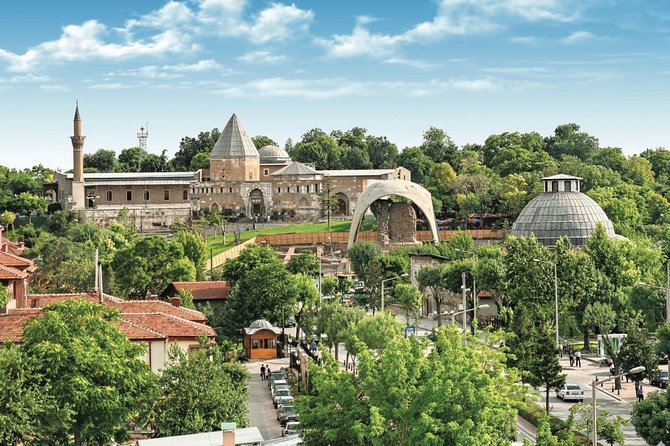
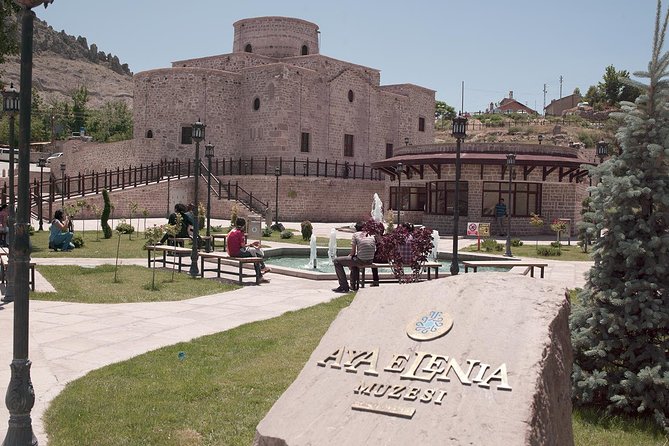
The Aya Elena Church receives about 20 minutes. Its story is linked with Helena, the mother of Byzantine Emperor Constantine. According to the tradition associated with the church, Helena stopped in Sille during a pilgrimage journey to Jerusalem, saw the carved temples, and commissioned the church.
This is a short visit, but it builds on what you have seen in Sille. Rather than treating the church as an isolated monument, the guide can connect it to the village’s early Christian identity.
Admission is included. Since the stop is brief, you should expect a focused explanation and a look around rather than a long period for independent study.
Shams-i Tabrizi: the companion behind Rumi’s inspiration
The final major stop is the tomb and mosque of Shams-i Tabrizi. Shams was Rumi’s spiritual guide, companion, and source of inspiration. For anyone trying to understand Rumi’s life, this visit fills in an important part of the story.
The stop lasts about 30 minutes and admission is free. It is smaller in scale than the Mevlana Museum, but its meaning is significant. Rumi’s work and spiritual development cannot be understood fully without knowing about Shams.
I like ending with this site because it brings the day back to the human relationship at the center of Konya’s Sufi story. After mosques, schools, churches, and village history, you return to the figures who give the city its emotional pull.
Lunch, transport, and the real value of $100
The price is $100 per person. That includes private transportation, a professional guide, all entrance fees, hotel pickup and drop-off, and an à la carte lunch with drinks.
That is a fair value if you are traveling alone, as a couple, or with a small private group and want to cover both Konya and Sille in one day. Separate transport, entry tickets, and a guide would take time to arrange, and the private vehicle keeps the day moving.
The value is less clear if you are happy using public transport, exploring independently, and spending only a few hours around the Mevlana Museum. In that case, a private full-day tour may offer more structure than you need.
Group discounts are offered, which can improve the cost for larger parties. Tips for the guide and driver are not included, so plan for those separately if you feel the service deserves it.
Lunch is another useful inclusion. You do not need to pause the sightseeing day to find a restaurant or handle a separate bill. The meal is à la carte, which gives you more choice than a fixed set menu, though the exact restaurant and dishes are not specified.
Who should book this experience?
I would recommend it most strongly to:
- First-time visitors with one day in Konya
- People interested in Rumi and Sufism who also want broader context
- Small groups who value a private guide and vehicle
- Visitors who want to see Sille without arranging separate transport
- Families or friends who prefer a flexible private schedule
- Anyone who wants lunch and entrance fees handled in one booking
It may be less suitable if you want a slow, specialist visit to every religious site. The schedule is broad, and some stops are necessarily short. You should also have a moderate level of physical fitness, since the day involves sightseeing and walking through historic areas.
Hotel pickup and drop-off are included. Service animals are allowed, and the tour is near public transportation, though the main convenience comes from the private vehicle.
The experience is listed with a 100 percent recommendation rate and a five-star rating from 71 reviews. More useful than the number itself is the repeated pattern in the feedback: guides Fatma and Mete are praised for professionalism, personal attention, flexibility, and clear explanations. One especially practical point is that the operator has arranged airport pickup for some visitors, but you should confirm that arrangement before booking because the standard inclusion specifically says hotel pickup and drop-off.
Timing, booking, and cancellation
The stated operating period runs from May 23, 2022, through May 21, 2026, with hours listed as Monday through Sunday, 9:30 AM to 4:30 PM. Confirmation is received at booking, and mobile tickets are available.
You can cancel for a full refund up to 24 hours before the start time. Changes or cancellations made less than 24 hours before the start time are not accepted for a refund, and cut-off times follow local time.
Because the day covers several sites and is often booked about 29 days ahead, I would reserve early if your Konya visit falls on a fixed date. Then confirm your pickup point, start time, and any special interests with the operator.
Should you book the Highlights of Konya tour?
Book it if you have one day and want Konya explained, not merely photographed. The combination of the Mevlana Museum, Seljuk monuments, Sille village, Christian churches, and Shams-i Tabrizi gives you a much more complete introduction than a city-center walk alone.
The strongest reasons to choose it are private transport, the ability to ask questions throughout the day, and the guide’s role in connecting Rumi with the wider story of Konya. The main compromise is pace. You will see many places, but only Sille and the Mevlana Museum receive about two hours.
For a first visit, I think that balance works. You get the city’s central spiritual sites, a striking village outside the center, lunch, and a guide who can adapt the conversation to your interests. If you prefer slow museum visits or already know Konya well, plan your own route instead. For everyone else, this is a practical way to make one day count.
FAQ
How long does the Highlights of Konya tour last?
The tour lasts approximately seven to eight hours.
Is this a private tour?
Yes. Only your group participates in the private tour or activity.
Is hotel pickup included?
Yes. Hotel pickup and drop-off are included.
What is included in the $100 price?
The price includes private transportation, professional guiding, all fees and taxes, entrance fees listed as included, and an à la carte lunch with drinks.
Is lunch included?
Yes. An à la carte lunch with drinks is included.
Which sites are included?
The route includes the Mevlana Museum, Alaeddin Mosque, Karatay Medresesi Museum, Aziziye Mosque, Sille village, Aya Elena Church, and the Shams-i Tabrizi Tomb and Mosque.
Are admission tickets included?
Admission to the Mevlana Museum, Karatay Medresesi Museum, and Aya Elena Church is included. Alaeddin Mosque, Aziziye Mosque, Sille, and the Shams-i Tabrizi Tomb and Mosque are listed with free admission.
What is the cancellation policy?
You can cancel at least 24 hours before the experience start time for a full refund. Cancellations or changes made less than 24 hours before the start time are not accepted for a refund.
Just added around Turkiye
- Whirling Dervish Show★ 4.8 · 21 reviews
- Whirling Dervish Ceremony İn Cappadocia★ 4.5 · 20 reviews
- Cappadocia Atv Tour : Full Extremly Atv Tour (Private Route)★ 4.5 · 66 reviews
- Red Dragon Pirate Boat Trip & Lunch★ 4.1 · 103 reviews
- Underground city tour & optional wine tasting★ 5.0 · 16 reviews
- Whirling Dervish Ceremony★ 4.5 · 35 reviews
- Visit to Cappadocia ceramic workshop and carpet store★ 4.6 · 19 reviews
- Istanbul:Whirling Dervish Ceremony, Mystical Sufi Experience★ 4.1 · 17 reviews