
Reviewed · TÜRKIYE
In The Footsteps Of Rumi
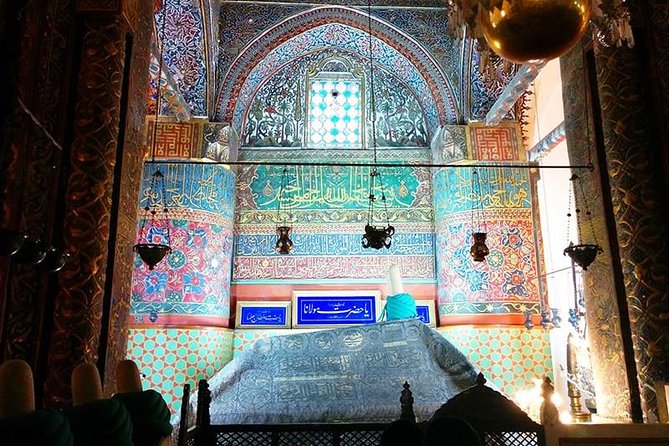
Konya’s most powerful sight is the Mevlana Museum, where Rumi’s tomb rests beneath a turquoise-tiled dome. This tour goes beyond that famous stop, linking Rumi to Shams-i Tabrizi, his cook, doctor, nanny, school, and the old gold bazaar where tradition says he first began to whirl.
I like the way the route joins spiritual ideas to real places, and I like that private transport lets you cover scattered sites without wrestling with Konya’s streets. Guides including Hayri, Fatma, Hüseyin, and Belkis have been praised for clear English, warm conversation, poetry, and strong knowledge of Sufism.
The main drawback is pace. Six to eight hours is a long day, and some stops are brief. If you want a full Mevlevi whirling ceremony, this tour is not advertised as a performance, so you should treat it as a historical and spiritual city tour instead.
In This Review
- Key points at a glance
- Why Rumi’s Konya needs more than one famous museum
- Two hours beneath the turquoise dome at Mevlana Museum
- Alaeddin Tepesi and the meeting of Rumi and Shams
- Iplikci Mosque and the school that disappeared
- Shams-i Tabrizi’s tomb and the gold bazaar’s hammering rhythm
- Ateşbaz-ı Veli and the sacred kitchen
- A doctor and a beloved nanny in the final stops
- The guide can change the whole experience
- Lunch, transport, and what the $100 price buys
- Who should book this private Konya tour?
- Practical details before you reserve
- Should you book In the Footsteps of Rumi?
- FAQ
- Where does the tour take place?
- How long does the tour last?
- Is the Mevlana Museum entrance included?
- Is lunch included?
- Is transportation provided?
- Is this a private tour?
- Is the tour available every day?
- Can I cancel for a full refund?
Key points at a glance
- Rumi’s tomb anchors the day: Spend about two hours at the Mevlana Museum, once a lodge for whirling dervishes.
- The route follows relationships: See places tied to Shams-i Tabrizi, Ateşbaz-ı Veli, Tabib Ekmeluddin, and Cemel Ali Dede.
- The gold bazaar carries a memorable story: Local tradition connects its hammering sounds with Rumi’s first whirling.
- Private transport saves time: The tour reaches sites spread around Konya, while lunch, entrance fees, and guiding are included.
- Guide quality matters here: Past guides named Hayri, Fatma, Hüseyin, and Belkis have been praised for English, storytelling, and Sufi knowledge.
- Expect a private, flexible-feeling day: Only your group participates, with pickup offered and mobile tickets available.
Why Rumi’s Konya needs more than one famous museum
Rumi is often reduced to a few soft-focus lines about love, but Konya presents a fuller picture. Mevlana Celaleddin-i Rumi was a 13th-century Muslim scholar, saint, poet, and mystic. His life was tied to teachers, companions, students, household workers, and the city around him.
That is what makes this route worthwhile. You do not simply enter a museum, take a photograph under the turquoise dome, and leave. You follow a chain of people and places that shaped the Mevlevi tradition, the Sufi order associated with Rumi and the whirling dervishes.
I especially like the human scale of the route. The stops include a cook, a doctor, and a childhood nanny, not only grand religious buildings. Those details help you see Rumi as a person living in medieval Konya, rather than as a distant name attached to poetry.
The tour lasts about six to eight hours. That gives you enough time for the central museum visit and a series of shorter stops, though the schedule may feel full. The private format is useful because your group alone participates, and private transport connects places that are not presented as one compact walking circuit.
Other Turkiye days worth putting on the list:
- Istanbul: Bosphorus Dinner Cruise & Show with Private Table
★ 4.8 · 44,561 reviews - Istanbul: Daytime or Sunset Sightseeing Cruise & Audio Guide
★ 4.8 · 14,430 reviews - Istanbul: Bosphorus Dinner Cruise with Turkish Night Show
★ 4.8 · 10,127 reviews
Two hours beneath the turquoise dome at Mevlana Museum

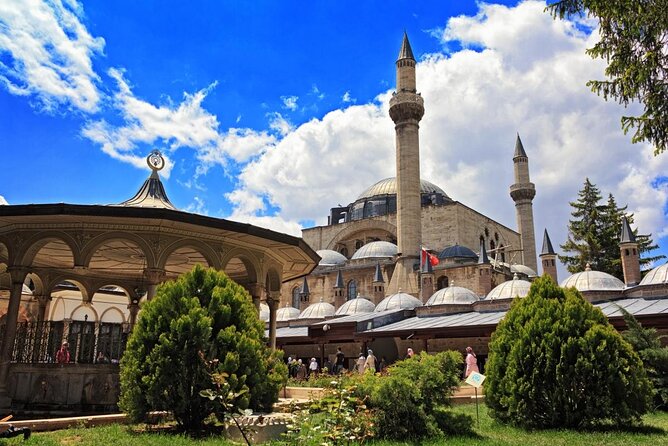
The Mevlana Museum is the heart of the experience. It occupies the former lodge of the whirling dervishes and contains the tomb of Rumi, who lived in the 13th century. The building’s fluted turquoise dome is among Konya’s most recognizable sights.
Allowing two hours here is sensible. This is not a place to rush through in ten minutes. The museum gives your guide room to explain the Mevlevi order, the role of the lodge, and the ideas behind Sufism before you move to the smaller places connected with Rumi’s life.
You will also pay respects at Rumi’s tomb. For Muslims and non-Muslims alike, this can be the most affecting part of the day, but it is important to approach it as a religious site, not just a monument. Dress and behave with respect, and listen to your guide’s advice about the setting.
The museum visit also gives needed context for later stops. Without it, a small tomb or mosque can seem like an isolated building. With it, the city’s network of teachers, friends, and servants begins to make sense.
The museum entrance is included in the tour price. That matters because the stop is the main admission-based visit listed, while the other sites are free to enter.
Alaeddin Tepesi and the meeting of Rumi and Shams
The route continues to Kultur Park and Alaeddin Tepesi, described as Marecel Bahreyn, the place where the two seas meet. This is linked to the first meeting of Rumi and Shams-i Tabrizi.
The scheduled stop is only about five minutes, so do not expect a long park visit or a detailed archaeological tour. Its value is symbolic. Your guide can connect this point with the meeting that changed Rumi’s spiritual and poetic life.
Shams was Rumi’s spiritual guide, inspiration, and companion. Their relationship is central to understanding why Rumi’s life and work took a new direction, and this short stop provides a physical point for that story.
I would listen closely here rather than focus on checking off another location. A brief place can still matter when the story attached to it is large. Since admission is free, there is no extra cost if the stop remains short.
Iplikci Mosque and the school that disappeared
Iplikci Mosque dates to 1202. Beside it once stood the Altunaba Madrasah, known as Rumi’s school, but the madrasah has not survived.
This is a useful stop for understanding how much of medieval Konya has vanished. You see the mosque, then learn that the adjoining institution where Rumi taught or studied is gone. The absence is part of the lesson. Cities preserve fragments, not complete scenes.
The visit lasts around 15 minutes and admission is free. That makes it a compact historical pause rather than a major interior visit. I would expect your guide to do most of the explaining here, since the lost madrasah cannot speak for itself through surviving rooms.
The mosque also places Rumi in the working religious life of Konya. He was not separated from the city in a private world of mystical verse. He taught, worshipped, met people, and developed his ideas within its institutions.
Same city, a completely different kind of day:
- Best of Istanbul 1, 2 or 3-Day Private Guided Istanbul Tour
★ 5.0 · 8,922 reviews - FOR CRUISERS: Skip The Lines PRIVATE EPHESUS TOUR &On Time Return
★ 5.0 · 8,527 reviews - Istanbul: Basilica Cistern Fast-Track Entry and Audio Guide
★ 4.6 · 7,521 reviews - Top Choice For Cruisers: Ephesus, Mary’s House WITH TICKETS+LUNCH
★ 5.0 · 7,233 reviews
Shams-i Tabrizi’s tomb and the gold bazaar’s hammering rhythm
Shams-i Tabrizi’s tomb and mosque are among the most important stops for anyone interested in Rumi’s spiritual path. Shams was not a minor acquaintance. He was the guide and companion who became a defining presence in Rumi’s life.
The visit lasts about 40 minutes when combined with the historic gold bazaar. That gives you more time than several of the other short stops, and rightly so. The connection between Rumi and Shams needs explanation, especially if you know Rumi mainly through modern translations of his poetry.
The gold bazaar adds a more unusual layer. According to local sources, this is where Rumi first began to whirl after hearing apprentices strike sheets of gold with their hammers. The sound is an evocative part of the story: ordinary work, repeated rhythm, and sudden spiritual movement.
You should treat this as a tradition connected with the site, not as a claim that can be proved by watching the same event today. Its appeal lies in how it links the mystical practice of whirling to the sounds and labor of everyday Konya.
This stop also helps explain why the whirling dervish tradition should not be viewed as a simple dance. The movement has religious meaning within Sufism and the Mevlevi order. Your guide’s explanation is important, since a short performance-style description would miss the point.
Ateşbaz-ı Veli and the sacred kitchen
Ateşbaz-ı Veli was Rumi’s cook. His tomb is tied to the kitchen, or Matbah-ı Şerif, an important part of Mevlevi dervish houses.
The scheduled visit takes about 30 minutes. That is enough time to give this often-overlooked figure his due. In a spiritual lodge, food preparation was not merely background work. The kitchen had an important place in daily discipline and community life.
This stop broadens the story beyond famous poets and teachers. Rumi’s world depended on people who handled practical duties, and Ateşbaz-ı Veli represents that side of the Mevlevi house.
I find this kind of stop more useful than another grand viewpoint. It shows how spiritual traditions are lived through routine, service, and shared spaces. If you are mainly interested in architecture, the tomb may be modest. If you want to understand how the order functioned, it earns its place on the route.
A doctor and a beloved nanny in the final stops
The tour returns to Kultur Park and Alaeddin Tepesi for the tomb of Tabib Ekmeluddin, Rumi’s doctor and one of the best-known doctors of the 13th century. This visit lasts about 15 minutes.
Again, the stop is short, but the detail is valuable. Rumi’s story included illness, care, and close personal connections. A doctor’s tomb reminds you that the spiritual figure also lived in a physical body, surrounded by people responsible for his health.
The final stop is Meram Baglari, where you visit the tomb of Cemel Ali Dede. He was Rumi’s nanny and a person who loved and respected him. The story says he received the name Cemel, meaning camel, because he entertained young Rumi by carrying him on his back.
That small story gives the day a gentle closing note. You have followed Rumi through formal religious sites and major spiritual relationships, then arrive at a memory from childhood. The 15-minute stop may be simple, but it gives the itinerary warmth and personality.
Meram Baglari also takes the route beyond the central museum zone. This is where private transport becomes useful, especially if you want to cover the full sequence without turning the day into a test of local navigation.
The guide can change the whole experience
This is a guide-led tour, and the guide is the key variable. Names associated with the experience include Hayri, Fatma or Fatima, Hüseyin, and Belkis, also spelled Bilkish in one account. Your assigned guide may be different.
The strongest guide descriptions focus on clear English, historical explanation, Sufi knowledge, and personal warmth. Hayri is described as well informed and able to make a solo visitor feel like a local friend was showing them Konya. Fatma is praised for blending stories with historical facts, while Belkis is described as passionate about Rumi and willing to include less familiar places.
One particularly distinctive strength is the use of poetry. A guide may read Rumi in Arabic, Persian, and English, giving you a sense of how his words move across languages. That is far more useful than hearing only a modern quotation without cultural or religious context.
Hüseyin’s approach has included Konya’s Seljuk period alongside Rumi’s life. That wider frame matters because the city was not built only around one mystic. Its political and architectural background helps explain why Rumi found such an important home here.
When you meet your guide, tell them what you want most: Rumi’s biography, Sufism, Mevlevi practice, Konya’s Seljuk past, poetry, or the city’s religious sites. The private format should make that conversation easier, though the supplied information does not promise a custom itinerary.
Lunch, transport, and what the $100 price buys
The price is $100 per person. Lunch, private transportation, all fees and taxes, and professional guiding are included. Tips for the guide and driver are not included.
For a six to eight-hour private experience, the price can make sense if you want interpretation rather than simple sightseeing. The value comes from the scattered route, the two-hour museum visit, transport between sites, and a guide who can explain Sufism and Rumi’s relationships.
It is less compelling if you only want to see the Mevlana Museum. The museum is the main draw, but this tour spends much of its time on smaller connected sites. If you prefer to move quickly and read plaques on your own, a shorter museum visit may suit you better.
Lunch is included, but no menu or restaurant details are provided. If you have dietary needs, ask about them when booking rather than assuming the meal will match your preferences.
Pickup is offered, and mobile tickets are available. The experience is listed for Monday through Sunday from 9:30 a.m. to 4:30 p.m. during the stated operating period, which runs through June 17, 2026. Confirmation is received at booking, and service animals are allowed.
Most people can participate, and the tour is near public transportation. Still, the day includes several religious sites and a mix of walking and riding, so comfortable shoes and respectful clothing are sensible choices.
Who should book this private Konya tour?
I would choose this for a first visit to Konya if Rumi is the reason you came, especially if you want the spiritual setting behind the poems. It suits solo visitors, couples, and small groups who prefer a conversation with one guide instead of a large group moving on a fixed script.
It is also a good fit if you want a more personal day. The private format means only your group participates, and the guide can explain why a modest tomb or lost school matters.
History lovers will appreciate the Seljuk references, Iplikci Mosque, and the remains of institutions tied to Rumi. People curious about Sufism will get more than a photograph of whirling dervishes, with attention to the order, its lodge, its kitchen, and its religious meaning.
I would hesitate to recommend it to someone seeking a formal whirling ceremony. The route explains the history of whirling and visits places tied to it, but the supplied details do not include a live sema performance.
The same goes for visitors with only a few free hours. The museum alone can be the priority, while this full route needs most of a day. The shorter stops are meaningful, but they may feel too quick if you want extended time at every tomb and mosque.
Practical details before you reserve
The tour has a five-star rating from 35 reviews, with 100 percent recommending it. The most consistent praise is aimed at the guides: their English, warmth, storytelling, and grasp of Rumi and Sufism.
You can cancel for a full refund if you do so at least 24 hours before the start time. Cancellations or changes made less than 24 hours before the start time are not accepted for a refund, and the cut-off follows local time.
The tour is booked, on average, 18 days ahead. That does not guarantee that every date fills, but it is a useful signal if your Konya schedule is fixed. Book early if you need a particular day or want to coordinate the tour with other Turkey connections.
Because the listed meeting information is limited, confirm the pickup point and start arrangements after booking. Pickup is offered, but the exact location is not specified in the details provided.
Should you book In the Footsteps of Rumi?
Book it if you want to understand Rumi through the people and places around him, not only through his tomb. The Mevlana Museum is essential, but Shams-i Tabrizi’s tomb, the gold bazaar story, the Mevlevi kitchen, and the small memorials to Rumi’s doctor and nanny give the day its character.
At $100, the tour is strongest when you value private transport, lunch, admission, and a guide who can explain poetry and Sufism in context. Skip it if you want a quick museum visit, a formal whirling performance, or a completely independent day.
For most first-time visitors with a full day in Konya, this is a thoughtful and unusually personal way to meet the city. Go ready to listen, ask questions, and give the short stops the attention they deserve.
FAQ
Where does the tour take place?
The experience takes place in Konya, Turkey, and visits the Mevlana Museum, Kultur Park and Alaeddin Tepesi, Iplikci Mosque, Shams-i Tabrizi’s tomb and mosque, the historic gold bazaar, Ateşbaz-ı Veli’s tomb, and Meram Baglari.
How long does the tour last?
The tour lasts approximately six to eight hours.
Is the Mevlana Museum entrance included?
Yes. Admission to the Mevlana Museum is included, along with all fees and taxes listed for the experience.
Is lunch included?
Yes, lunch is included in the $100 per-person price. Specific restaurant and menu details are not provided.
Is transportation provided?
Yes. Private transportation is included, and pickup is offered.
Is this a private tour?
Yes. Only your group participates in the activity.
Is the tour available every day?
The listed operating hours are Monday through Sunday, from 9:30 a.m. to 4:30 p.m., during the stated operating period ending June 17, 2026.
Can I cancel for a full refund?
Yes, if you cancel at least 24 hours before the experience start time. Cancellations or changes made less than 24 hours in advance are not accepted for a refund.
Just added around Turkiye
- Whirling Dervish Show★ 4.8 · 21 reviews
- Cappadocia Atv Tour : Full Extremly Atv Tour (Private Route)★ 4.5 · 66 reviews
- Whirling Dervish Ceremony İn Cappadocia★ 4.5 · 20 reviews
- Red Dragon Pirate Boat Trip & Lunch★ 4.1 · 103 reviews
- Underground city tour & optional wine tasting★ 5.0 · 16 reviews
- Whirling Dervish Ceremony★ 4.5 · 35 reviews
- Visit to Cappadocia ceramic workshop and carpet store★ 4.6 · 19 reviews
- Istanbul:Whirling Dervish Ceremony, Mystical Sufi Experience★ 4.1 · 17 reviews