
Reviewed · EPHESUS TOURS
NEW: Private The Most Detailed Ephesus Shore Excursion / with Lunch
Ephesus is far more than a quick photo at the Library of Celsus. This private tour gives you time for the city’s grand Roman streets, its political centers, wealthy homes, early Christian sites, and the remains of the Temple of Artemis. Guides such as Selin, Nesli, Ahmet, Asli, and Özgür have earned especially warm praise for making the ancient stones easy to understand.
I like the private Mercedes van, which keeps the ride cool and gives your group room to adjust the day. I also like the Turkish lunch, especially since the meal can be a welcome break after hours on stone streets and hills. The main drawback is cost: the advertised $79.20 does not include several entrance fees, which can add up quickly.
In This Review
- Key points to know before you book
- Why this private Ephesus tour works well
- From Kusadasi to Mary’s House
- Ephesus begins on Harbour Street
- The State Agora and the business of government
- The Odeon, the Senate, and the Temple of Domitian
- Hercules Gate and Curetes Street
- Hadrian’s Temple and the Terrace Houses
- The Celsus Library and the Great Theatre
- Artemis, St. John, and the final part of the day
- Lunch, shopping, and the real cost
- Who should book this experience?
- Should you book the Ephesus private excursion?
- FAQ
- How long does the Ephesus private excursion last?
- Is pickup included?
- Is the tour private?
- Is lunch included?
- What language is the tour offered in?
- Are entrance fees included?
- What level of fitness is needed?
- Can cruise passengers book this tour?
- Can I cancel for a full refund?
Key points to know before you book
- The tour covers far more than the famous library: Expect political buildings, baths, fountains, latrinas, temples, houses, and streets.
- Private guiding makes the day flexible: Guides have adjusted the pace for families, children, and specific interests.
- Lunch is included, but drinks are not: The meal is described as plentiful, with olive oil, figs, and pomegranate flavors appearing in some outings.
- Entrance fees are extra: Ephesus, Mary’s House, the Terrace Houses, and St. John’s Basilica together total €79 per person.
- The Terrace Houses cost extra but add real depth: Their mosaics and frescoes show how wealthy Roman families lived.
- Watch the clock if you are on a cruise: One outing returned late, so confirm the timing with your guide early in the day.
Why this private Ephesus tour works well
Ephesus rewards a guide who can explain what you are looking at. Without context, a broken column is only a broken column. With the right explanation, the same stone may reveal how city government worked, how water reached the streets, how Roman homes were arranged, or why an emperor’s temple mattered to local status.
This experience covers that wider story. You see the famous sights, but you also spend time at places many quick visits skip, including the State Agora, Odeon, Temple of Domitian, Hercules Gate, and Terrace Houses. That makes the tour a good fit if you want more than the standard library-and-theatre route.
The private format matters in Ephesus. Your guide can slow down at the Celsus Library, move briskly through a place that interests you less, or explain details for children without holding up a large group. One guide, Tas, was especially praised for working well with both adults and children aged 13 and 7. That is useful evidence for families deciding between a private visit and a fixed group schedule.
The published duration is about five to seven hours. That is a wide range because the day can change with your pickup point, traffic, walking speed, lunch, and the amount of time you spend at each site. Cruise passengers should be very clear about the ship’s docking, disembarkation, and re-boarding times.
More Ephesus Tours in Kusadasi
- FOR CRUISERS: Skip The Lines PRIVATE EPHESUS TOUR &On Time Return
★ 5.0 · 8,527 reviews - Top Choice For Cruisers: Ephesus, Mary’s House WITH TICKETS+LUNCH
★ 5.0 · 7,233 reviews - PRIVATE EPHESUS TOUR FOR CRUISERS: On-time Return and Skip-Line
★ 5.0 · 5,807 reviews
From Kusadasi to Mary’s House
Pickup is offered from the cruise port, a hotel, or the domestic airport. Cruise passengers meet the driver at the exit gate of the immigration terminal, where an OTTI Travel sign should be visible. Hotel pickup is at reception, and airport pickup is at the domestic terminal exit.
The first stop is Meryemana, known as the House of Virgin Mary. You have about 30 minutes here, and the admission fee is separate. The site is meaningful for Christian pilgrims and for anyone interested in the traditions connected with Mary’s final years.
This is a short stop rather than a long archaeological visit. I would treat it as a quiet beginning to the day, not as a substitute for Ephesus itself. Your guide can help place the site within the wider story of John, Mary, and the early Christian community around Ephesus.
Ephesus begins on Harbour Street
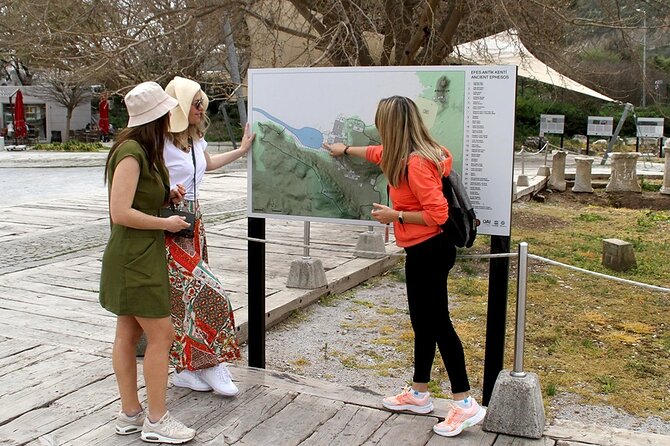
The ancient city opens with the scale of a real urban center. Harbour Street leads toward the Great Theatre and gives you an early sense of how carefully the city was laid out. The route then moves through Marble Street, Curetes Street, the Commercial Agora, and the State Agora.
The major two-hour visit includes many of Ephesus’s best-known remains:
- Harbour Street and the Great Theatre
- Marble Street and Curetes Street
- The Celsus Library
- The Gate of Mihridates and Mazues
- The Commercial Agora
- Public latrinas
- Hadrian’s Temple
- The Scholastica Baths
- Trajan’s Fountain
- The Polio Fountain
- The Memnius Monument
- The Temple of Domitian
- The Prytaneion
- The Odeon and State Agora
That list is important because it shows how much ground this tour covers. You are not simply walking from one famous facade to another. You are seeing the civic, religious, commercial, and social parts of the city.
Wear sturdy shoes. The streets are ancient, uneven, and often sloped. The tour requires a moderate level of physical fitness, and the full route can feel demanding in warm weather. The air-conditioned vehicle helps between sites, but it does not reduce the walking inside the ruins.
The State Agora and the business of government
The State Agora is easy to mistake for a marketplace, but its main purpose was government business. Built in the first century BC during the Roman period, it served as a meeting place for official discussions rather than everyday buying and selling.
That detail gives the site unusual value. Ephesus was not only a port and commercial center. It was also a city where public decisions were debated and made. Excavations in the northeastern corner found graves dating from the seventh and sixth centuries BC, along with an ancient road and a terra-cotta sarcophagus. The area had once served as a cemetery during the archaic period.
A water reservoir at the agora also points to the practical side of urban life. Water arrived through the Pollio Aqueduct, remains of which can be seen several kilometers away along the Selçuk-Aydin highway. Your guide can connect the reservoir, aqueduct, fountains, baths, and latrinas into one clear story about city infrastructure.
Same city, a completely different kind of day:
- PRIVATE NO HIDDEN FEES Ephesus, Mary’s House Guided Tour /GRP OPT
★ 5.0 · 2,455 reviews - For Ship Guests:BEST SELLER EPHESUS PRIVATE TOUR & On Time Return
★ 5.0 · 2,029 reviews - ALL INCLUDED: Ephesus Ruins, Mary’s House Tour incl ENTRY TICKETS
★ 5.0 · 1,670 reviews - Ephesus Temple of Artemis and House of Mary Private Half Day Tour
★ 5.0 · 1,573 reviews
The Odeon, the Senate, and the Temple of Domitian
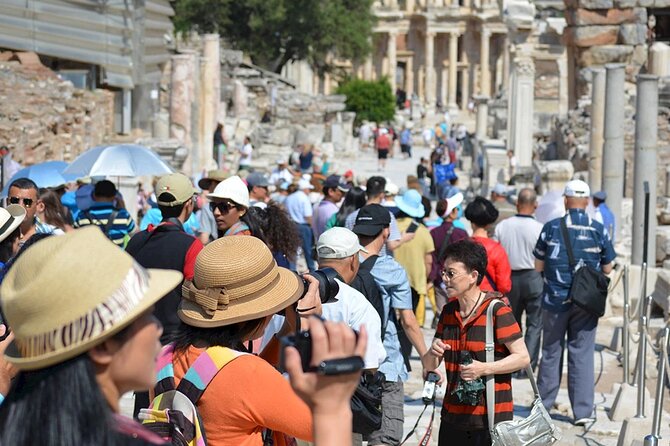
The Odeon is a small theatre with room for about 1,500 people. It had two jobs. The Boule, or Senate, met here, and musical performances took place in the same space.
This helps explain the political structure of Ephesus. The public Demos met in the Great Theatre, while the Boule gathered in the smaller Odeon. The contrast between the two buildings is more interesting than either one alone. One was built for a broad public audience, the other for a smaller governing body.
You then reach the Temple of Domitian, located at the southern end of Domitian Street. It was the first known Ephesus structure dedicated to an emperor. The temple occupied a large raised terrace, with stairs still visible on the northern side.
The temple’s importance was political as much as religious. Ephesus received permission to become a neokoros, a city authorized to maintain an imperial cult temple. That was a major honor in the Roman world and a sign of the city’s standing.
Hercules Gate and Curetes Street
Hercules Gate marks a change in the feel of the route. Only the two sides of the gate remain, but the relief of Hercules explains its name. The columns were moved to their current location in the fourth century AD, while the relief dates from the second century.
The gate narrowed Curetes Street so vehicles could not pass. By the fourth century, this part of the city had become a pedestrian area. It is a small detail, but it lets you picture ancient daily life more clearly. People were walking the same route, stopping at fountains, shops, temples, and public buildings, while carts were kept out.
This is a good place to ask your guide about street use, trade, and movement through the city. Private tours are at their best when you can pause for those questions instead of simply following a script.
Hadrian’s Temple and the Terrace Houses
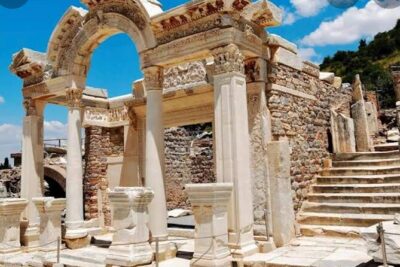
Hadrian’s Temple is one of Ephesus’s most graceful surviving structures. Built before AD 138, it was dedicated to Emperor Hadrian after his visit to the city in AD 128. Four Corinthian columns support the facade, with a curved arch containing a relief of Tyche, the goddess associated with fortune and victory.
The bases in front once supported statues of four later emperors: Diocletian, Maximian, Constantius I, and Galerius. The statues themselves are gone, but the setting shows how the street continued to be updated as rulers changed.
Across from the temple, the Terrace Houses offer a different view of Ephesus. These were the homes of wealthy Roman families, built on three terraces at the lower end of Bulbul Mountain. Six residential units have been identified, with the oldest construction dating to the first century BC and occupation continuing until the seventh century AD.
Two houses are open as a museum under protective roofing. You can see floor mosaics and wall frescoes, along with the layout of domestic rooms. This is one of the best parts of the tour for anyone who wants to understand family life instead of only public monuments.
There are stairs, and one guide specifically noted that the climb was worth it. The Terrace Houses have a separate €15 admission fee, but I consider them one of the most useful optional costs on the day.
The Celsus Library and the Great Theatre
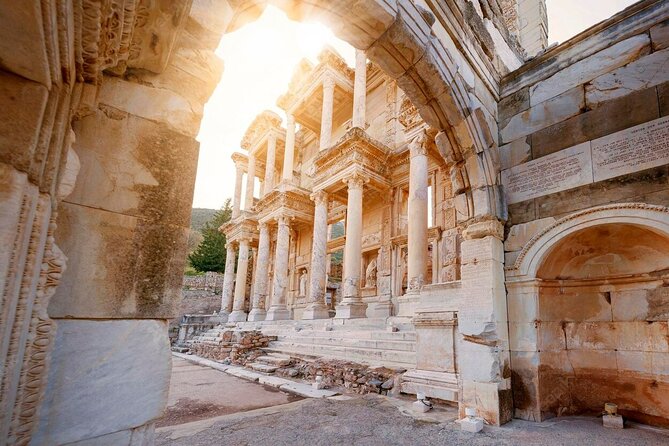
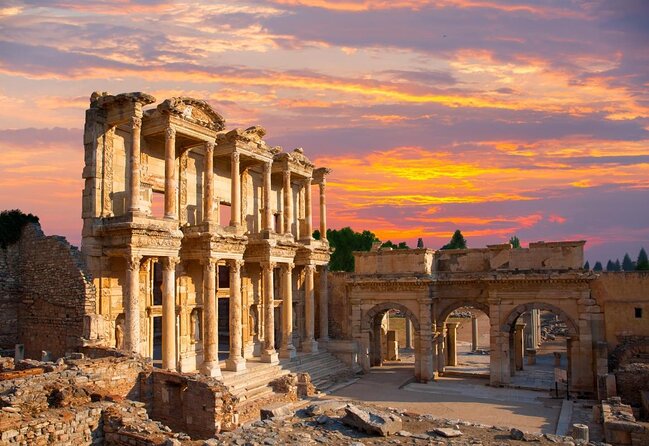
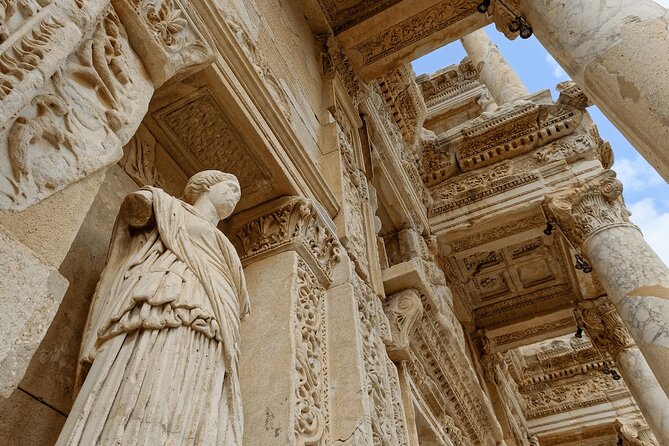
The Library of Celsus is Ephesus’s signature view. Completed in AD 117, it was built as a monumental tomb for Gaius Julius Celsus Polemaeanus, governor of the province of Asia. His grave lay beneath the ground floor, across from the entrance.
The building held more than 12,000 scrolls. Double walls behind the bookcases helped protect the collection from temperature and humidity changes. Statues represented qualities such as wisdom, knowledge, intelligence, and virtue, with Athena associated with the tomb.
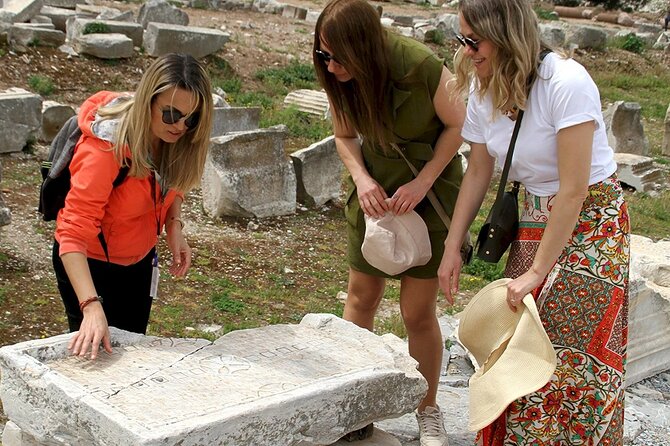
Take time here. The facade photographs well, but your guide can help you notice the building’s purpose, its memorial role, and the engineering behind the book storage. The library is not just a pretty Roman facade.
The Great Theatre is larger and more forceful. First built in the Hellenistic period, it was expanded under Roman rule until it reached a capacity of about 25,000 seats. Sixty-six rows were arranged in three sections, divided by two walkways.
The theatre hosted plays and concerts, but also religious events, political gatherings, philosophical discussions, gladiator contests, and animal fights. Its position opposite Harbour Street explains why it made such a strong impression on people entering the city.
Admission to the theatre is included in the Ephesus ticket, not in the tour price. The separate Ephesus Ancient City admission is listed as €40 per person.
Artemis, St. John, and the final part of the day
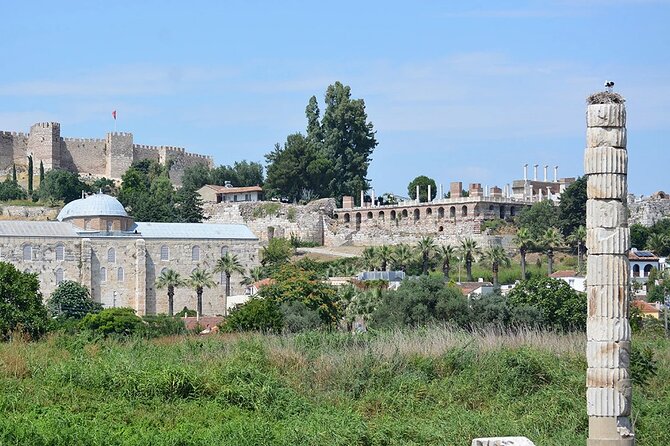
The Temple of Artemis was one of the Seven Wonders of the ancient world. Today, very little remains on the original site, which gradually became marshland. You see the foundations and a surviving column, while many of the finest sculpted pieces are displayed in the British Museum in London.
This stop takes about 40 minutes. It is best for setting expectations: you are visiting the location and remains of a famous temple, not a complete standing monument. The contrast between ancient fame and present fragments is part of the lesson.
The final major stop is the Basilica of St. John on Ayosolug Hill. Tradition holds that John spent his final years near Ephesus and was buried on the southern slope. A small chapel was built over the grave in the fourth century, then expanded into a large basilica under Emperor Justinian between AD 527 and 565.
The site connects Ephesus to the early Christian world. Tradition also says John brought Mary to the region, wrote his Gospel in Ephesus, and wrote Revelation on Patmos in AD 96. The basilica’s €6 admission is extra.
Lunch, shopping, and the real cost
Lunch is included, which gives the day a useful pause. The meal is described as good and plentiful, and some outings included local figs, fresh pomegranate juice, and a memorable olive oil and pomegranate dressing. Drinks cost extra, so keep that in mind when comparing the headline price.
Some departures also include a carpet-weaving presentation after lunch. I see value in learning how Turkish rugs are made, especially if you are curious about local craft. The sales portion can last longer than you want, and the shop staff may encourage you to buy. You can politely decline, but ask your guide at the start how much time is planned for this stop.
At $79.20 per person, the tour price is attractive for private transport, a licensed English-speaking guide, parking, lunch, and pickup and drop-off. But the entrance fees are significant:
- Ephesus Ancient City: €40
- Mary’s House: €18
- Terrace Houses: €15
- St. John’s Basilica: €6
That adds €79 per person if you visit every listed paid site. Lunch drinks are also separate. The guide may arrange tickets in advance, which can save you from waiting in line, but you still pay the admission cost.
Who should book this experience?
I would choose this tour if you want a full Ephesus day with private attention, a broad route, and the freedom to ask questions. It suits couples, families, and small groups who prefer a personal pace over a large coach.
The strongest guide names to request, if available, are Selin, Nesli, Ahmet, Asli, Özgür, Tas, Mary, Mehmet, and Devon. The experience depends heavily on the person leading it, and these guides have been singled out for warmth, clear explanations, family skills, and flexible planning.
I would be cautious if you dislike long archaeological walks, extra admission charges, or any shopping presentation. Cruise passengers should also build in a clear return-time discussion. One outing reached the ship late, and the cruise line allowed extra time, but you should not depend on that kind of luck.
Should you book the Ephesus private excursion?
Book it if Ephesus is a priority and you want the city explained rather than merely photographed. The private van, included lunch, broad site coverage, and guide flexibility make the base price a good starting value, even after admissions are added.
Before paying, budget for the €79 in entrance fees, confirm which sites you want to enter, ask how long lunch and any carpet stop will take, and give the operator your full cruise schedule. With those details settled, this is a strong choice for seeing Ephesus in depth without surrendering your day to a fixed group timetable.
FAQ
How long does the Ephesus private excursion last?
The experience lasts approximately five to seven hours. The exact length can vary with pickup location, walking pace, lunch, traffic, and the time spent at each site.
Is pickup included?
Yes. Pickup and drop-off are included from the Kusadasi cruise port, hotels, and the domestic airport. Cruise passengers meet the representative at the exit gate of the immigration terminal.
Is the tour private?
Yes. Only your group participates in the private activity.
Is lunch included?
Yes. Lunch is included, but drinks at lunch are not included.
What language is the tour offered in?
The tour is offered in English and includes an English-speaking professional licensed guide.
Are entrance fees included?
No. The listed entrance fees are separate. Ephesus costs €40, Mary’s House costs €18, the Terrace Houses cost €15, and St. John’s Basilica costs €6 per person.
What level of fitness is needed?
A moderate level of physical fitness is recommended. The tour includes extended walking on ancient streets and stairs, especially around the Terrace Houses.
Can cruise passengers book this tour?
Yes. Cruise passengers must provide the ship name, docking time, disembarkation time, and re-boarding time when booking. You should also confirm the planned return time with the guide.
Can I cancel for a full refund?
Yes. You can cancel at least 24 hours before the experience start time for a full refund. Changes or cancellations made less than 24 hours before the start time are not accepted or refunded.
More Lunch Experiences in Kusadasi
- SKIP-THE-LINE: Group & Private Ephesus Tour ENTRY FEE & LUNCH
★ 5.0 · 935 reviews - ALL INCLUSIVE Private Ephesus, House of Virgin Mary with lunch
★ 5.0 · 819 reviews - Ephesus: Mary’s House Private & Group Tour with Ticket+Lunch
★ 4.8 · 738 reviews - ALL INCLUSIVE Private Ephesus, House of Mary, LUNCH, Entrances
★ 5.0 · 735 reviews
More Shore Excursions in Kusadasi
- Kusadasi Shore Excursion: Ephesus Sightseeing Tour with Lunch
★ 4.5 · 145 reviews - Kusadasi Shore Excursion : Ephesus Private Tour ONLY FOR CRUISE GUESTS
★ 5.0 · 101 reviews - Ephesus Shore Excursion: Private Guide and Vehicle
★ 4.5 · 98 reviews - Best Seller: Private Ephesus Shore Excursion from Kusadasi Port
★ 5.0 · 69 reviews
Just added around Kusadasi
- FOR CRUISERS /Top Seller Ephesus Private Tour / On Time Return★ 5.0 · 21 reviews
- Small Group Ephesus and Sirince Day Tour from Kusadasi/Selcuk★ 5.0 · 23 reviews
- FOR CRUISERS: Best of Ephesus Private Tour (SKIP-THE-LINE & ON-TIME RETURN)★ 5.0 · 40 reviews
- Private Tour : Biblical Ephesus Tour for Cruisers from Kusadasi ( Ephesus ) Port★ 5.0 · 55 reviews
- FROM IZMIR Cruise Port: Ephesus and Mary’s House Private Tour★ 5.0 · 21 reviews
- Private Tour FOR CRUISE GUESTS: Best of Ephesus Private Tour / SKIP THE LINE★ 5.0 · 43 reviews
- Private Tour : Customized Ephesus Tour for Cruisers from Kusadasi Ephesus Port★ 5.0 · 16 reviews
- Private Ephesus Tour From KUSADASI port★ 5.0 · 41 reviews
Ephesus Tours, compared.
FOR CRUISERS: Skip The Lines PRIVATE EPHESUS TOUR &On Time Return
Read our review →
For Ship Guests:BEST SELLER EPHESUS PRIVATE TOUR & On Time Return
Read our review →
ALL INCLUDED: Ephesus Ruins, Mary’s House Tour incl ENTRY TICKETS
Read our review →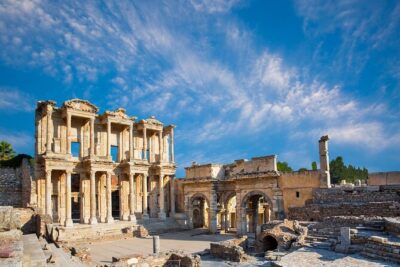
PRIVATE TOUR FOR CRUISERS: Mary’s House (Meryemana) and Ephesus
Read our review →
Top-Rated: Ephesus & Artemis Tour for Cruisers WITH ENTRY TICKETS
Read our review →
SKIP-THE-LINE: Group & Private Ephesus Tour ENTRY FEE & LUNCH
Read our review →
All Inclusive Private Access Ephesus Tour (SKIP-THE-LINE)
Read our review →Browse the lists this tour appears in