
Reviewed · EPHESUS TOURS
Tailor-Made Private Ephesus Tour with Local Experiences
Ephesus is the star here, but the real advantage is having a private guide and driver to shape the day around your interests. You can spend more time on the Library of Celsus and Terrace Houses, focus on early Christian sites, or trim stops that matter less to you.
I like the comfortable Mercedes Vito, the included Turkish lunch, and the way guides such as Nagi, Asli, Selin, Tas, and Ahmet have adjusted the pace for families, cruise passengers, and visitors with specific interests. The main catch is cost: the $75 tour price does not include most entry fees, so a full day can cost much more.
In This Review
- Key points to know before booking
- Why a private Ephesus day makes sense
- Starting at the House of the Virgin Mary
- Walking through the ancient city of Ephesus
- State Agora and the political side of Ephesus
- The Odeion and Ephesus under public debate
- Temples, emperors, and the Hercules Gate
- Inside the Terrace Houses
- The Library of Celsus and Ephesus at its grandest
- The Great Theatre and the early Christian story
- St. John Basilica and the Temple of Artemis
- Lunch, weaving, and the local angle
- Kusadasi caravanserai and the bazaar
- Transport, timing, and physical effort
- Who should book this tour
- Should you book it?
- FAQ
- Where does the tour take place?
- How long does the tour last?
- Is the tour private?
- Is pickup included?
- Where do cruise passengers meet the guide?
- Is lunch included?
- Are Ephesus entrance tickets included?
- What other admission fees are extra?
- Can the itinerary be changed?
- What level of fitness is needed?
Key points to know before booking
- Private touring makes Ephesus flexible: Only your group joins, and the schedule can be adjusted to suit your interests and energy.
- The archaeological core is the main event: The Library of Celsus, Great Theatre, Curetes Street, and Terrace Houses give you the clearest sense of ancient city life.
- The House of Mary adds a religious dimension: It is a peaceful mountain shrine, but the walk includes steep sections.
- Lunch is part of the experience: A local Turkish meal is included, along with a short carpet or silk-weaving presentation at some lunch venues.
- Entrance fees change the value calculation: The listed extra fees total €79 per person if you visit every chargeable site.
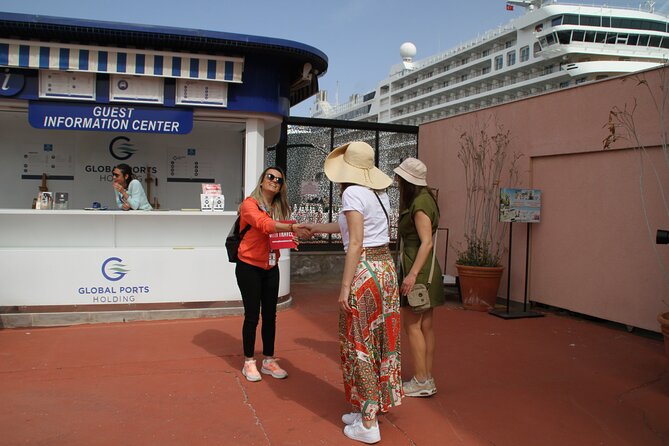
- Cruise timing is taken seriously: You provide ship and reboarding details, then meet the guide at the Kusadasi port exit with an OTTI Travel sign.
Why a private Ephesus day makes sense
Ephesus is too large and too important for a quick photo stop. Its marble streets, theaters, public squares, temples, homes, and Christian landmarks spread across a broad area. A private tour gives you a person who can explain what you are seeing instead of leaving you to decode a field of columns and fallen stones.
The private format also helps with pace. You can linger at the Library of Celsus, ask questions about early Christianity, or skip a stop without affecting a busload of strangers. Several guides have been praised for checking the pace, adapting the plan, and explaining the day before setting off.
That matters most on a cruise stop. You do not want to spend half your port visit waiting for late passengers or worrying about a rigid schedule. Pickup and return are arranged around the ship’s docking and reboarding times, although you must provide those details when booking.
The price begins at $75 per person, which is appealing for a private vehicle, licensed English-speaking guide, driver, and lunch. Yet the headline price is not the final price. Ephesus costs €40, the House of Mary €18, the Terrace Houses €15, and St. John Basilica €6. Visiting all four adds €79 per person before drinks or optional Şirince Village, listed at $50 per booking.
More Ephesus Tours in Kusadasi
- FOR CRUISERS: Skip The Lines PRIVATE EPHESUS TOUR &On Time Return
★ 5.0 · 8,527 reviews - Top Choice For Cruisers: Ephesus, Mary’s House WITH TICKETS+LUNCH
★ 5.0 · 7,233 reviews - PRIVATE EPHESUS TOUR FOR CRUISERS: On-time Return and Skip-Line
★ 5.0 · 5,807 reviews
Starting at the House of the Virgin Mary
The House of the Virgin Mary sits on Bulbul Mountain, about 9 kilometers from Ephesus. The setting is quiet and green, a sharp change from the exposed stone and crowds of the ancient city below.
The small stone structure is traditionally associated with Mary’s final years. The tradition says she came to the area with St. John, who spent time here spreading Christianity. The site combines a house, chapel, candle area, and prayer spaces used by both Christian and Muslim visitors.
You receive about 45 minutes here. The House of Mary costs €18, and admission is not included in the tour price. The setting is the main appeal, especially if religious sites matter to you, but do not expect a large museum or grand church.
Pay attention to the walking conditions. The approach includes a steep section, and one guide arranged for the vehicle to collect a family member who had difficulty walking back uphill. If anyone in your party has hip or mobility concerns, mention that before the tour begins.
Walking through the ancient city of Ephesus
Ephesus is the center of the day, and you should allow yourself time to look up, down, and sideways. The marble paving can be slippery, so shoes with a firm grip are more useful than stylish sandals.
The city grew from Greek foundations into one of the major urban centers of the Roman East. The Artemision, or Temple of Artemis, once ranked among the Seven Wonders of the ancient world. Ephesus later became known for its public buildings, medical school, religious life, and large civic spaces.
The main route links several stops. Your guide can explain how the city functioned, not just identify each ruin. That distinction is important because Ephesus is easier to understand when the streets are treated as part of a working city rather than a collection of monuments.
The stated time at the ancient city is about 90 minutes, though the overall schedule is flexible. If you want detailed explanations and photographs, ask to give Ephesus priority over minor stops. The ancient city admission is €40 and is not included.
State Agora and the political side of Ephesus
The State Agora sits south of the Basilica. Unlike a commercial marketplace, this Roman-era square served government business and public discussion.
It was built in the first century BC and later reused in ways that reveal how the city changed. Excavations found older graves from the seventh and sixth centuries BC, an ancient paved road, and a terra-cotta sarcophagus. A water reservoir here was fed through the Pollio Aqueduct, whose remains can still be seen several kilometers away.
The stop is brief, about 15 minutes. I would not treat it as a major destination on its own, but it helps you understand the civic machinery behind Ephesus. Ask your guide to connect the agora with the city’s councils and public buildings.
Same city, a completely different kind of day:
- PRIVATE NO HIDDEN FEES Ephesus, Mary’s House Guided Tour /GRP OPT
★ 5.0 · 2,455 reviews - For Ship Guests:BEST SELLER EPHESUS PRIVATE TOUR & On Time Return
★ 5.0 · 2,029 reviews - ALL INCLUDED: Ephesus Ruins, Mary’s House Tour incl ENTRY TICKETS
★ 5.0 · 1,670 reviews - Ephesus Temple of Artemis and House of Mary Private Half Day Tour
★ 5.0 · 1,573 reviews
The Odeion and Ephesus under public debate
The Odeion looks like a small theater, with seating, an orchestra, and a stage building. It served two roles: a concert hall and the meeting place of the Boule, or Senate.
Built in the second century AD by wealthy residents Publius Vedius Antonius and Flavia Paiana, it held about 1,500 people. The original building had a wooden roof, and parts of the seating and podium have been restored.
This stop takes about 15 minutes. Your guide can use it to explain the two governing bodies of Ephesus. The larger public assembly met in the Great Theatre, while the smaller council met here. That is a useful bit of context that is easy to miss when you are only looking at the stonework.
Temples, emperors, and the Hercules Gate
The Temple of Domitian was the first known temple at Ephesus dedicated to a Roman emperor. It occupied a large terrace supported by vaulted foundations, with stairs still visible on the northern side.
Only fragments remain, but the site explains the political importance of emperor worship. Being recognized as a city authorized to maintain an imperial temple was a major civic honor.
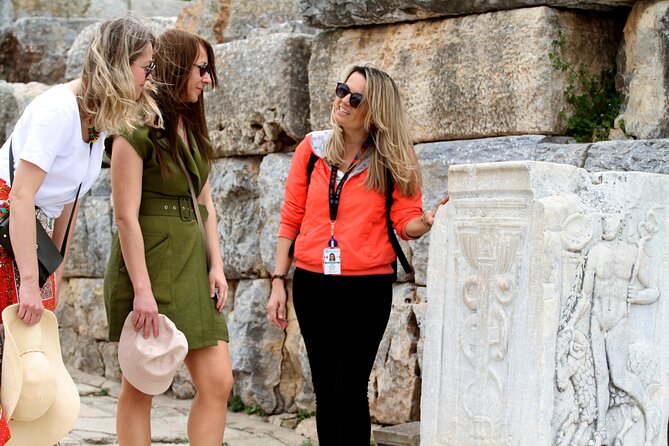
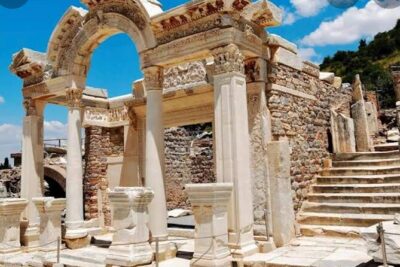
The Temple of Hadrian is more visually complete. Its Corinthian columns and curved arch make it one of the prettiest structures along Curetes Street. It was dedicated to Emperor Hadrian after his visit in AD 128. The relief in the arch depicts Tyche, a goddess associated with fortune and victory.
The Hercules Gate is another short but worthwhile stop. Its surviving columns carry reliefs of Hercules, though the gate was moved to its current location in the fourth century. It narrowed the street and eventually prevented wheeled traffic, showing that Curetes Street had become pedestrian-only by that period.
These stops are usually quick, 10 to 15 minutes each. They work best when your guide explains how religion, government, and daily movement through the city were connected.
Inside the Terrace Houses
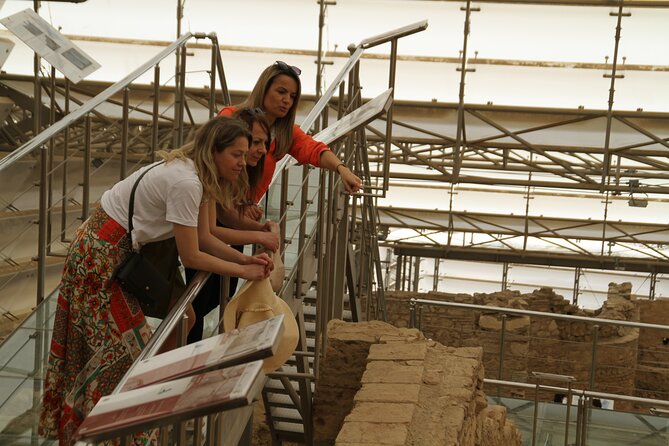
The Terrace Houses are among the best reasons to choose this tour over a basic ancient-city visit. These were homes of wealthy Roman families, built into the hillside opposite the Temple of Hadrian.
Six residential units occupied three terraces. The oldest began in the first century BC, and the homes remained in use until the seventh century AD. Their mosaics, wall paintings, courtyards, and room layouts offer a rare look at private life rather than public ceremony.
Protective roofing now covers the site, and two houses are open as a museum. You can see how floors and walls were decorated, and how residential areas were arranged on the slope.
Admission costs €15. The scheduled visit is about 30 minutes, but this is one stop worth extending if you enjoy architecture, domestic life, and details such as mosaics. Some people prefer to spend that money on the Terrace Houses rather than add every other optional site. Ask your guide for a recommendation based on your interests.
The Library of Celsus and Ephesus at its grandest
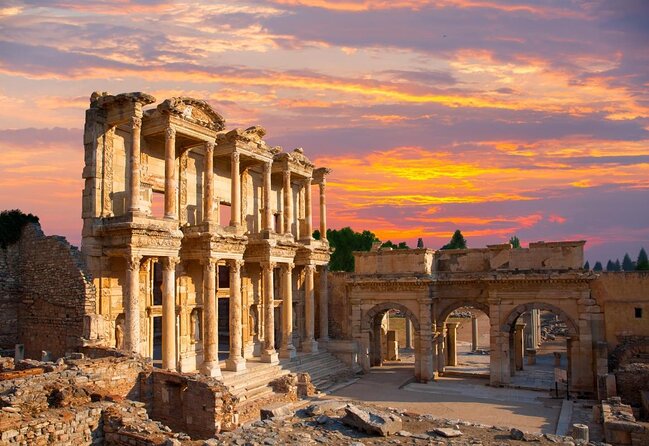
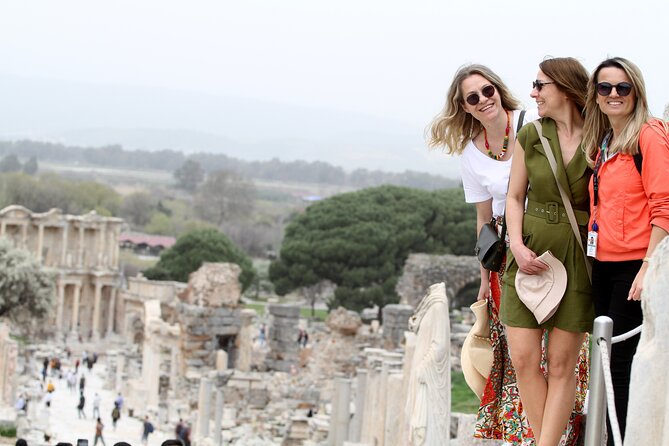
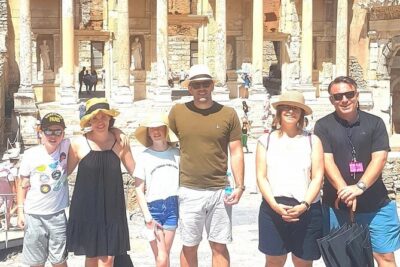
The Library of Celsus is the image most people carry home from Ephesus. Its two-story facade, columns, statues, and careful reconstruction make it easy to imagine the old city at full scale.
The building was completed in AD 117 as a monument and tomb for Gaius Julius Celsus Polemaeanus, governor of the province of Asia. His tomb lay beneath the ground floor. The library held more than 12,000 scrolls, stored in wall niches protected by a second wall that helped limit heat and moisture.
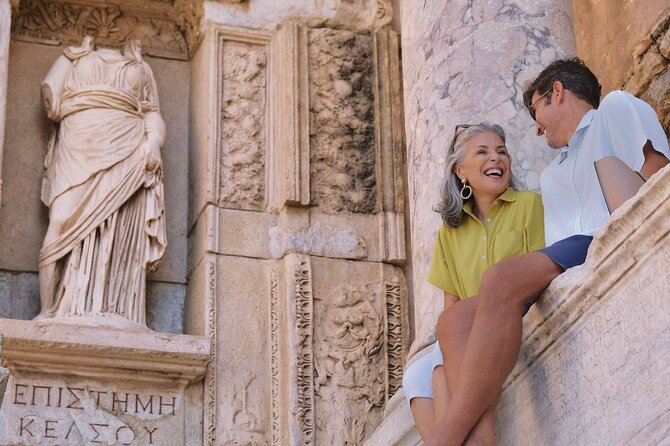
Your guide can point out the symbolic statues on the facade and explain why a library was also used to honor a powerful Roman official. Allow time for photographs, but expect this to be one of the busiest points on the route. Guides such as Selin have been especially good at choosing quieter moments for major sights, so your private schedule can help.
The Great Theatre and the early Christian story
The Great Theatre is the largest theater in Anatolia, with room for about 25,000 people. It began in the Hellenistic period and was expanded under Roman rule.
The seating rises on the slope of Panayir Hill opposite Harbor Street. The theater hosted plays and concerts, but also religious ceremonies, political meetings, philosophical debate, and gladiator or animal contests. Its scale gives you a clear sense of Ephesus as a major city, not a small provincial settlement.
The theater also connects to the Christian story of Ephesus. St. Paul is associated with the city, and Christian tradition places St. John and Mary in the region. If that part of the past interests you, say so when booking. One guide, Tailan, was specifically praised for explaining Christian history, scripture, legends, and local traditions in a way that suited a family’s questions.
The scheduled stop is 15 minutes, which is enough for a look but not a full exploration. You may want to request more time here if theater architecture matters to you.
St. John Basilica and the Temple of Artemis
St. John Basilica sits on the southern slope of Ayosolug Hill. Tradition says the Evangelist John spent his final years near Ephesus and was buried here. A small chapel was built over the grave in the fourth century, and Emperor Justinian later ordered a large basilica.
The ruins are spread across the hill, so the experience differs from the compact monuments inside Ephesus. Admission is €6, with about 30 minutes planned for the visit.
The nearby Temple of Artemis is a quick stop with a long story. One of the Seven Wonders of the ancient world, it was a vast marble temple dedicated to Artemis. Today, only foundation remains and a few scattered architectural pieces mark the site. Admission is free, and the visit takes about 25 minutes.
Do not come expecting a complete temple. The value lies in understanding the size and fame of what once stood there, then comparing that achievement with the few remains visible today.
Lunch, weaving, and the local angle
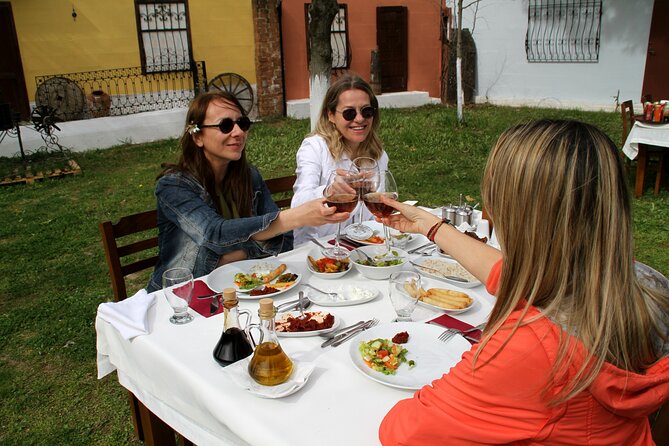
Lunch is included, which improves the day’s value and gives you a break from the ruins. The meal is described as local Turkish food, including mezze at some venues.
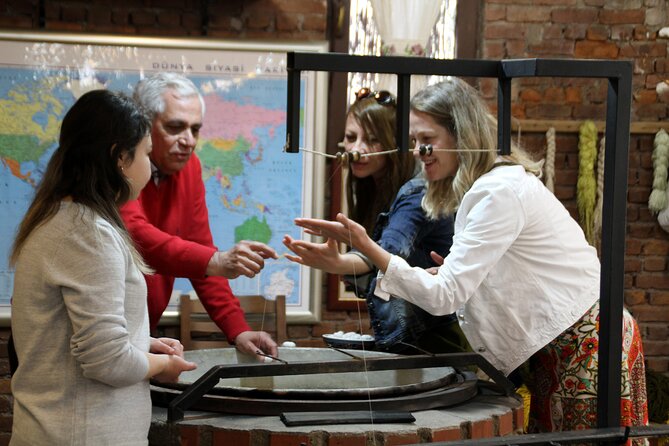
Some lunch stops are connected with a carpet-weaving school or cooperative. You may see how silk is made, from mulberry leaves and silkworm cocoons to the finished thread. This can be a useful introduction to a local craft, especially if you are curious about village production and handwoven carpets.
You should also understand the sales setting. One guide described the demonstration as more of a sales pitch, while another family found no pressure to buy. Your experience may depend on the venue and guide. If you do not want to shop, say so clearly at the start. If you are considering a Turkish carpet, this is a chance to ask about materials, weaving, and origin, but do not feel obliged to purchase.
Kusadasi caravanserai and the bazaar
The final part of the day returns you to Kusadasi. Öküz Mehmet Pasha Caravanserai was built between 1615 and 1618 as a fortified customs house. Its restoration took place from 1954 to 1966 after the building had nearly fallen into ruin.
The visit lasts about 10 minutes and admission is free. It is a modest but useful Ottoman-era counterpoint to the Greek and Roman remains earlier in the day.
You then receive about an hour at the Kusadasi bazaar. Shops sell Turkish goods, leather, sweets, souvenirs, clothing, watches, and assorted small items. Some merchandise is clearly aimed at cruise traffic, so browse with a practical eye. The bazaar is not the most authentic stop on the tour, but it gives you time to shop or simply walk around town before returning to your hotel or ship.
Transport, timing, and physical effort
The tour lasts about six to eight hours. You travel in a new air-conditioned Mercedes Vito with a private driver, a welcome comfort during a full day of outdoor sightseeing.
Cruise passengers meet at the exit gate of the immigration terminal, where an OTTI Travel representative holds a sign. Hotel pickup takes place at reception. Izmir Airport pickup is also offered at the domestic terminal exit.
You need moderate physical fitness. The day includes walking over uneven and sometimes slippery ancient paving, hills at the House of Mary and St. John Basilica, and outdoor exposure at Ephesus. A private vehicle helps reduce unnecessary walking between sites, but it does not turn the tour into a low-mobility outing.
Guides have included Nagi, Asli, Selin, Tas, Ahmet, Sergen, Elif, Gunes, Chan, and Tailan. The strongest pattern is personal attention: clear English, historical explanation, good timing, and willingness to adjust the route. Still, guide quality can vary from person to person, so use the booking notes to state your interests, pace, and any sites you want to skip.
Who should book this tour
I would choose this for a couple, family, or small group that wants control over the day. It is especially useful for cruise passengers, first-time visitors to Ephesus, and anyone who wants a guide to explain Roman, Greek, Ottoman, and Christian sites in one outing.
It also suits families with mixed interests. Teenagers can get the big theater and city streets, while adults can focus on the Terrace Houses, religious sites, or local food. A private guide can shorten the parts that lose your group’s attention.
The tour is less attractive if you want the lowest possible total price. Once entrance fees are added, the day costs far more than $75 per person. It is also not ideal if you dislike shopping presentations, since the weaving-school lunch stop may include a carpet display.
Cancellation is free up to 24 hours before the start time. Confirmation arrives at booking, and cruise passengers must provide ship, docking, disembarkation, and reboarding details.
Should you book it?
Book this tour if you value a private vehicle, an adaptable schedule, and a guide who can make Ephesus understandable rather than merely scenic. The strongest use of your time is Ephesus itself, the Terrace Houses, the Great Theatre, the Library of Celsus, and either the House of Mary or St. John Basilica, depending on your interests.
Before paying, calculate the entrance fees and decide which stops matter most. Tell OTTI Travel if you want Christian context, extra time for archaeology, help with mobility, or no carpet shopping. With those details settled, the $75 starting price can be good value for a full private day, but it should not be mistaken for the complete cost.
FAQ
Where does the tour take place?
The tour is based in Kusadasi, Turkey, and visits Ephesus and nearby historical sites.
How long does the tour last?
The experience lasts approximately six to eight hours.
Is the tour private?
Yes. Only your group participates in the private tour or activity.
Is pickup included?
Yes. Pickup and drop-off are offered for cruise passengers and Kusadasi hotel pickups. Pickup from Izmir Airport is also available.
Where do cruise passengers meet the guide?
Cruise passengers meet at the exit gate of the immigration terminal at Kusadasi Cruise Port. The guide or representative carries an OTTI Travel sign.
Is lunch included?
Yes. A local lunch is included. Alcoholic beverages are not included.
Are Ephesus entrance tickets included?
No. Admission to Ephesus is listed at €40 per person and must be paid separately.
What other admission fees are extra?
The House of Mary costs €18, the Terrace Houses €15, and St. John Basilica €6 per person. The Temple of Artemis and Öküz Mehmet Pasha Caravanserai are listed as free.
Can the itinerary be changed?
The private format allows the schedule to be tailored to your group. You can discuss which stops to include, skip, or emphasize with the guide.
What level of fitness is needed?
A moderate fitness level is recommended. Expect walking on ancient stone paving, along with steep sections at some sites.
Just added around Kusadasi
- FOR CRUISERS /Top Seller Ephesus Private Tour / On Time Return★ 5.0 · 21 reviews
- Small Group Ephesus and Sirince Day Tour from Kusadasi/Selcuk★ 5.0 · 23 reviews
- FOR CRUISERS: Best of Ephesus Private Tour (SKIP-THE-LINE & ON-TIME RETURN)★ 5.0 · 40 reviews
- Private Tour : Biblical Ephesus Tour for Cruisers from Kusadasi ( Ephesus ) Port★ 5.0 · 55 reviews
- FROM IZMIR Cruise Port: Ephesus and Mary’s House Private Tour★ 5.0 · 21 reviews
- Private Tour FOR CRUISE GUESTS: Best of Ephesus Private Tour / SKIP THE LINE★ 5.0 · 43 reviews
- Private Tour : Customized Ephesus Tour for Cruisers from Kusadasi Ephesus Port★ 5.0 · 16 reviews
- Private Ephesus Tour From KUSADASI port★ 5.0 · 41 reviews
Ephesus Tours, compared.
FOR CRUISERS: Skip The Lines PRIVATE EPHESUS TOUR &On Time Return
Read our review →
For Ship Guests:BEST SELLER EPHESUS PRIVATE TOUR & On Time Return
Read our review →
ALL INCLUDED: Ephesus Ruins, Mary’s House Tour incl ENTRY TICKETS
Read our review →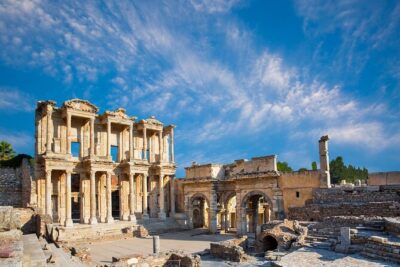
PRIVATE TOUR FOR CRUISERS: Mary’s House (Meryemana) and Ephesus
Read our review →
Top-Rated: Ephesus & Artemis Tour for Cruisers WITH ENTRY TICKETS
Read our review →
SKIP-THE-LINE: Group & Private Ephesus Tour ENTRY FEE & LUNCH
Read our review →
All Inclusive Private Access Ephesus Tour (SKIP-THE-LINE)
Read our review →Browse the lists this tour appears in